


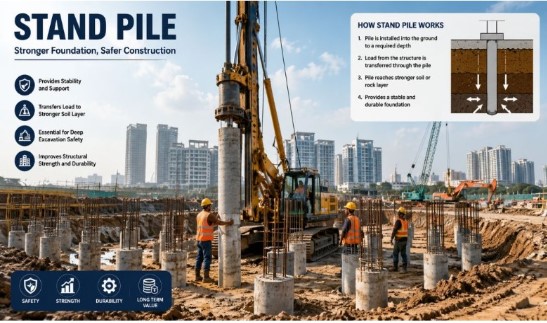
Introduction to Stand Pile
The term stand pile is commonly used in construction and engineering discussions, although it is often confused with similar terms such as “steel pile” or “standing pile.” In practical usage, a stand pile generally refers to a structural pile element that is installed vertically into the ground and remains in a stable standing position to support loads from buildings, bridges, and other heavy structures.
In civil engineering, piles are essential deep foundation elements designed to transfer structural loads to deeper, stronger soil layers. A stand pile plays a crucial role in ensuring that structures remain stable, safe, and durable over time, especially in areas where surface soil is weak or unstable.
This article explains everything about stand piles in a clear, detailed, and SEO-friendly manner, including their meaning, types, applications, installation methods, and advantages.
What is a Stand Pile?
A stand pile can be defined as a vertical structural element driven or cast into the ground to provide deep foundation support. It is called “stand” pile because it stands firmly in an upright position after installation and carries heavy vertical or horizontal loads.
Stand piles are typically made from reinforced concrete, steel, or timber (in older or temporary structures). These piles are installed deep into the soil until they reach a load-bearing stratum such as hard clay, dense sand, or rock.
Key Function of Stand Pile
The primary purpose of a stand pile is to transfer building loads safely into deeper soil layers, prevent structural settlement, increase stability of heavy constructions, and provide resistance against wind, water, and seismic forces.
Importance of Stand Pile in Construction
Stand piles are essential in modern construction because surface soil is often not strong enough to support large structures. Without deep foundations like stand piles, buildings may experience uneven settlement or even collapse.
Why Stand Piles Are Important
They provide strong deep foundation support, prevent structural sinking or tilting, improve load distribution, are suitable for weak or waterlogged soil, and enhance earthquake resistance.
In cities with high-rise buildings and coastal construction, stand piles are considered a fundamental part of foundation engineering.
Types of Stand Piles
There are several types of stand piles used depending on soil conditions, structural requirements, and load capacity.
1. Driven Stand Piles
Driven stand piles are installed by hammering or vibrating them into the ground. They are pre-made in factories and installed using heavy machinery. They are suitable for sandy or soft soil and offer fast installation with high load-bearing capacity.
2. Bored Stand Piles
Bored piles are created by drilling a hole into the ground and then filling it with concrete. They are constructed on-site, reinforced with steel bars, and ideal for urban areas with vibration restrictions. They produce less noise and offer high flexibility in size and depth.
3. Timber Stand Piles
Timber piles are one of the oldest types of piles used in construction. They are made from treated wood and used in temporary or light structures. They are cost-effective and commonly used in wet or marine environments.
4. Steel Stand Piles
Steel piles are strong and durable structural elements made from high-quality steel sections. They are widely used in bridges and skyscrapers due to their high strength, long service life, and ability to withstand heavy loads.
Materials Used in Stand Piles
Stand piles are made using different materials depending on project requirements.
Reinforced Concrete
Reinforced concrete is the most widely used material due to its strength, durability, and cost efficiency.
Steel
Steel is used in projects requiring high load resistance and flexibility, especially in large infrastructure works.
Timber
Timber is used for temporary structures or areas exposed to water where treated wood can perform effectively.
How Stand Piles Are Installed
The installation process of stand piles depends on their type, but the general steps remain similar.
Step 1 – Site Investigation
Engineers analyse soil conditions to determine pile depth and type.
Step 2 – Marking and Positioning
Exact pile locations are marked on the construction site.
Step 3 – Drilling or Driving
Driven piles are hammered into the ground, while bored piles are drilled and then filled with concrete.
Step 4 – Reinforcement Placement
Steel reinforcement is added to increase strength and durability.
Step 5 – Concrete Pouring
Concrete is poured to form a solid structural pile.
Step 6 – Curing and Testing
The pile is allowed to set and is tested for load-bearing capacity.
Applications of Stand Pile
Stand piles are widely used in many construction projects.
Building Foundations
Used in residential and commercial buildings for deep foundation support.
Bridges
Essential for supporting bridge piers and handling heavy traffic loads.
Marine Structures
Used in docks, harbours, and offshore platforms.
High-Rise Buildings
Critical for skyscrapers where structural loads are extremely high.
Road and Railway Projects
Used to stabilise infrastructure built on weak soil conditions.
Advantages of Stand Pile
Stand piles offer many benefits in modern engineering.
High Load Capacity
They can carry extremely heavy structural loads safely.
Stability in Weak Soil
Ideal for areas where surface soil cannot support structures.
Long-Term Durability
Properly installed piles can last for decades with minimal maintenance.
Earthquake Resistance
They improve structural stability during seismic activity.
Reduced Settlement Risk
They help prevent uneven sinking of buildings.
Limitations of Stand Pile
Despite their benefits, stand piles also have some limitations.
High Installation Cost
Deep foundation systems can be expensive to install.
Requires Heavy Equipment
Special machinery is needed for installation.
Time-Consuming Process
Some pile systems take longer to complete.
Soil Dependency
Effectiveness depends heavily on accurate soil analysis.
Stand Pile vs Other Foundation Types
Stand piles are often compared with shallow foundations.
Shallow Foundations
Used for light structures, installed near the surface, and less expensive but not suitable for heavy loads.
Stand Piles
Used for heavy structures, installed deep into the ground, and far more stable and reliable in weak soil conditions.
Future of Stand Pile Technology
Modern construction technology is improving stand pile systems significantly. Innovations include eco-friendly materials, smart monitoring sensors, advanced drilling methods, and high-performance concrete mixtures. These improvements are making foundations stronger, safer, and more efficient.
Conclusion
A stand pile is a vital component in civil engineering that ensures deep foundation support for structures built on weak soil. It provides strength, stability, and long-term safety for buildings, bridges, and infrastructure projects. From small residential buildings to massive skyscrapers, stand piles play a crucial role in modern construction by transferring loads safely into the ground and preventing structural failure.
