


Poland, with almost 40 million people, is a strong option for global brands that want to grow in Europe. Its economy is growing, more people have higher incomes, and the media market is active and competitive. This makes Poland a good place for brands to reach a large audience and build real interest in what they offer.
Poland’s advertising market is also growing fast, with forecasts of about 6-8% growth each year. A big reason is the quick move to digital channels, which now shape many marketing plans. For international companies that want to get real results here, it helps to understand how advertising in Poland works in practice. Agencies with local knowledge and wide services can help brands use this market in the best way.
What Drives the Increasing Importance of Advertising in Poland for Global Brands?
Why Are Global Brands Targeting the Polish Market?
Global brands are paying more attention to Poland for several clear reasons. Poland is the sixth-largest economy in the European Union and often shows solid growth, usually around 3-4% per year. This growth links to higher wages, lower unemployment, and more consumer spending. When people have more money to spend, brands have a better chance to sell goods and services.
Poland also offers a strong strategic benefit. Compared to many Western European markets that are crowded and expensive, Poland often has lower entry costs and more affordable media prices. This can help international brands build reach without the very large budgets needed in older, more expensive markets.
How Does Poland’s Economic Growth Influence Advertising Value?
Steady economic growth in Poland increases the value brands can get from advertising. GDP growth, changes in consumer spending, and stable inflation all affect how confident companies feel about investing in marketing. When disposable income rises, brands often increase budgets because the audience is more ready to buy.
Even when other regions cut ad spend during uncertain times, Poland has often stayed stable. The country’s policies that support new tech and offer tax benefits for some business activities also help the ad market move forward. These conditions support smarter campaigns and more local targeting, which can make ad spend more efficient.
What Makes Poland’s Consumer Market Attractive for International Advertisers?
Poland is attractive to advertisers because many consumers are active online and their buying habits are changing. By 2025, close to 90% of people in Poland are expected to use the internet, with over 34 million users and more than 75% active on social media. Mobile use is also very high, with mobile connections above 140%, which means many people use more than one device. Smartphones are common, and people often research and shop across devices.
Many Polish consumers also like ads that feel personal and interactive. They often care about honesty from brands and clear information about products. This is especially true for younger people, who prefer brands that match their values, such as sustainability and social responsibility. While many shoppers still focus on price, growing middle and higher-income groups are paying more attention to quality and brand reputation. This mix of strong digital use, value-based decisions, and rising interest in premium products makes Poland a lively market for international advertisers.
Key Figures: Poland’s Advertising Spend and Market Growth
Annual Advertising Spend: Trends and Numbers
Poland’s ad market is growing quickly, with forecasts of 6-8% growth each year. In 2023, online ad spending alone went above 7.8 billion PLN, showing a clear move of budgets into digital. Content marketing is also growing: about 60% of companies planned to raise their budgets, while only 3.4% planned cuts.
Content marketing in Poland is also becoming more mature. Senior leaders are more involved in planning and decision-making. Over 14% of Polish companies spend more than one million PLN per year on content marketing (about $270,000). This shows content is no longer a small side project-it is a serious part of marketing plans.
Digital vs. Traditional Media: Where Are Budgets Allocated?
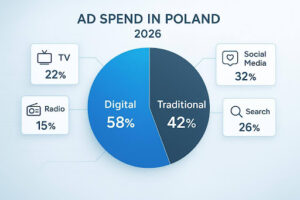
Poland’s ad market is shifting strongly to digital. Online channels now take more than half of total ad budgets, and digital is the main source of growth. By 2026, about 79% of total ad spend in Poland is expected to come from digital, showing how strongly brands are changing their media mix.
Even with this shift, traditional channels still matter. Radio and Out-of-Home (OOH) ads keep a strong position because they reach large local audiences. TV is still often seen as the most effective channel, reaching almost every home and taking a large share of ad revenue, especially for products that see strong sales gains after TV campaigns. Print is changing in the digital era, but it still works well for focused audiences, including niche markets and trusted business titles.
Which Industries Dominate Ad Spend in Poland?
Some sectors lead ad spend in Poland, especially online. Retail and e-commerce are the biggest drivers, responsible for about 40% of all online ad contacts in 2023, and this stayed similar through mid-2025. This matches Poland’s strong e-commerce growth and the competition to win shoppers online. Retail, consumer electronics, and entertainment (media, books, gaming) often spend the most on digital campaigns.
Other sectors are increasing spend too. Automotive and travel brands are putting more money into digital because the buying journey now starts online for many people. By mid-2025, brands and platforms like Temu, Media Expert, and Allegro were among the most visible online advertisers, showing how competitive the top categories have become.
Major Advertising Channels for Global Brands in Poland
Digital and Social Media Platforms
Digital and social platforms are key for global brands in Poland. Major global platforms like Google, YouTube, and Meta (Facebook and Instagram) drive large amounts of ad traffic, along with strong local platforms such as Allegro, Onet, and WP. Google Ads (Search, Display, Shopping) is important for catching users with clear buying intent and driving sales. Meta is widely used for brand awareness, promotions, and community-building, with strong reach across age groups and a particular strength in the 25-54 segment.
YouTube is popular across all ages, making it a major channel for video ads. TikTok is growing fast and is very effective for reaching people under 30 with short videos. For B2B marketing, LinkedIn helps advertisers target professionals, especially in tech and services. Overall, online ads can reach about 87% of the Polish population, which shows how much reach digital channels can offer.
TV, Radio, Out-of-Home, and Print
Traditional media still has strong influence in Poland. TV remains a major channel and is often seen as the most effective form of advertising because it reaches almost every home through local stations or satellite. Products promoted on TV often show strong sales growth, and a large part of ad revenue still goes to TV, even though high demand can push prices up for premium time slots.
Radio is also a strong channel, with 297 stations reaching both cities and smaller towns. Popular stations include RMF FM, Radio ZET, Radio Eska, and Jedynka (Polskie Radio). Out-of-Home (OOH) and Digital Out-of-Home (DOOH) ads are important in cities. Transport ads on buses, trams, and metro systems give high visibility in large cities like Warsaw, Kraków, Wrocław, and Gdańsk, where millions commute daily. Print media-national newspapers like Rzeczpospolita and Gazeta Wyborcza, niche magazines, and business titles like Forbes and Newsweek Polska-still works well for targeted groups, including decision-makers and trade audiences.
Video, Influencer, and Performance Marketing
Video is one of the fastest-growing areas in Poland’s ad market. Pre-roll ads on YouTube and other streaming sites work well, especially on mobile. Video formats often get higher visibility and engagement (about 63% in-view) than static banners (about 48%). This trend also shows in content marketing: more than 70% of budgets go into production, with video making up 80% of all content created. Video output grew by 35% year over year, while long-form native articles grew by 18%.
Influencer marketing is also common, especially through YouTubers and creators on Instagram and TikTok. Many brands now focus less on raw reach and more on performance based on real engagement. About 60% of surveyed organizations say content marketing works for awareness and engagement and supports long-term relationships. Companies also focus more on “attention” results: 82% are willing to pay for guaranteed attention effects, and all of the largest companies said they will pay more for high-quality audiences who stay with content, such as reading a full article or watching a video to the end.
Programmatic and Retail Media Innovations
Programmatic is quickly becoming the main way digital ads are bought in Poland, helping brands target more precisely and scale campaigns more easily. By 2026, about 79% of Poland’s digital ad revenue is expected to come through programmatic buying. Programmatic mobile ads look especially promising because of strong mobile use and frequent online activity.
Retail media is also changing online advertising. With online retail expected to go above $26 billion by 2025, shoppable ads are growing fast. These include Google Shopping Ads, Instagram Shopping tags, and dynamic product ads that let people buy directly from an ad. Brands also use catalog-based ads and partner with large platforms like Allegro Ads and Ceneo for sponsored listings. This supports smoother “ad to cart” experiences for Polish shoppers who often compare products across devices.
Opportunities and Challenges for International Advertisers in Poland
Consumer Behavior and Local Market Nuances
International advertisers need a clear view of Polish consumer behavior. Many people value quality and good service, but they also pay close attention to price. That’s why promotions, discounts, and coupons often work well. Consumers are open to trying new products, especially when they see them advertised on TV or hear about them on radio. Many also like ads that feel personal and interactive, and they respond well to brands that are open and honest.
There are also regional differences. People in larger cities often have more spending power than those in rural areas. Word-of-mouth is still very influential, even with strong advertising campaigns. Many buyers research and compare options before purchasing, which makes retargeting useful. While many people prefer Polish-made products, e-commerce and global marketplaces are changing this, creating opportunities for international brands that can build trust.
Content Localization, Language, and Cultural Relevance
For global brands, localization is a must for success in Poland. Most consumers expect ads in Polish and like references that feel familiar. Campaigns that adjust language, local expressions, visuals, and seasonal traditions usually perform better and build more trust. In business communication, Polish companies often reply faster when messages are in Polish, and translations from English work best when handled by skilled translators who know modern business Polish and correct grammar.
Studies show that Polish consumers have mixed feelings about globalized ads. They may like the polished look of standard international campaigns, but they often rate localized ads as more effective. This is a key point: a message that works in one culture may not work in another. Brands that adapt to local culture tend to see stronger results.
Competition With Domestic Polish Brands
Poland is a large market, but competition is rising. International brands compete with both other global companies and strong local Polish brands. For example, U.S. products are often compared with similar goods made in Europe, and the cheapest option often wins. Customs duties, VAT, and excise taxes on non-EU imports can also raise final prices, which can give EU-based producers an advantage.
If a company is not well known in Poland, it may need to invest heavily in marketing, training, and promotions to build credibility, often by partnering with a local agency like BE Media. Many businesses succeed faster when they have a local presence through an agent, distributor, or representative office. This reduces concerns about distance and service—two areas that matter a lot to Polish customers. Some U.S. companies have even set up distribution or production sites in Europe to compete more effectively.
Regulation, Data Privacy, and Compliance Issues
Working in Poland’s ad market also means understanding regulations that focus on consumer protection and data privacy. Poland follows EU rules like GDPR and the ePrivacy directive, which affect how brands collect and use data for targeting. Advertisers often need clear user consent through cookie banners, and many brands are shifting to first-party data because many users do not like tracking.
Google’s planned phase-out of third-party cookies (expected in late 2024) adds more pressure to use alternatives like contextual targeting and server-side tracking, and many agencies in Poland are testing Privacy Sandbox tools. Content rules matter too. EU laws cover misleading and comparative advertising (Directive 2006/114/EC) and unfair business practices like deceptive marketing (Directive 2005/29/EC). The Digital Services Act bans targeted ads for children and ads based on sensitive data, while the Digital Markets Act requires clear consent for combining personal data for targeted ads by major platforms. The AVMS Directive sets rules for broadcasting, including product placement and limits on junk food ads to children. There are also strict rules for ads about medicines and health/nutrition claims, aimed at transparency and safety across media.
Emerging Trends Shaping Poland’s Advertising Landscape
The Role of Artificial Intelligence and Automation
AI is quickly changing advertising in Poland by improving targeting and making campaign work faster. Brands use machine learning to build better audience segments, including lookalike models that find people similar to existing customers. AI is also used for automatic bid optimization, helping campaigns perform better within set budgets. AI content tools such as ChatGPT have also become widely used. A mid-2025 survey showed about one-third of Polish internet users use these platforms, which points to real change in how content is created.
Personalization powered by AI is a major focus for advertisers. Dynamic ads can change in real time based on user actions, making messages more relevant. AI chatbots are also common for customer support and lead generation on websites and social channels. Soon, conversations with AI assistants may even influence ad delivery, pushing targeting even further. This wide use of AI improves efficiency and can raise returns for marketers in Poland.
Rise of Mobile and In-App Advertising
Mobile use is a major feature of the Polish market, which makes mobile and in-app advertising more important each year. With mobile connections above 140%, smartphones are a daily tool for most people. This supports a mobile-first approach, especially because younger adults (18-34) are very comfortable with technology and expect smooth mobile experiences.
In-app ads, including rewarded videos in mobile games, often get strong engagement, especially with younger groups. Many marketers see programmatic mobile ads as a strong way to reach these users with better targeting. As people spend more time in apps and on phones, these channels give brands direct, immersive ways to connect.
Growth of Shoppable Media and eCommerce Advertising
Poland’s fast-growing e-commerce market is pushing the rise of shoppable media and e-commerce-focused ads. With online retail expected to pass $26 billion by 2025, and more than half of internet users shopping online (often using multiple devices for research), there is strong demand for ads that lead straight to purchase. Formats like Google Shopping Ads, Instagram Shopping tags, and dynamic product ads (including retargeting on Facebook) help shorten the path from interest to checkout.
Polish shoppers respond well to smooth “ad to cart” journeys, which shows the value of reducing steps and friction. Catalog-based ads are especially useful for companies selling products. Partnerships with marketplaces like Allegro Ads and Ceneo for sponsored listings can also raise visibility and sales. This link between ads and direct buying is changing how brands drive conversions online.
Measurement, Attribution, and ROI Expectations
In Poland, brands are changing how they measure campaign success. Instead of focusing only on reach, impressions, and clicks, more advertisers want proof of real engagement and attention. Many companies now pay more for “quality audiences”-people who spend more time with content, such as reading a full article or finishing a video.
About 82% of companies, and 100% of the largest ones, say they are willing to pay for guaranteed attention effects. While the market still needs better shared standards for these quality metrics, the demand shows that measurement is becoming more advanced. Strong tracking across channels and smart retargeting are also key, especially since Polish buyers often research and compare before buying. This puts ROI expectations at the center of many campaigns.
Actionable Recommendations for Global Brands Entering the Polish Market
Aligning Strategies With Polish Consumer Insights
For global brands entering Poland, results start with real local consumer knowledge. Many Poles like quality and strong service, but price still matters a lot. Brands should balance good value with competitive pricing, and promotions like contests and coupons often work well. Campaigns should also be adapted to local culture and values, because generic messaging often fails. Using the right language, local expressions, familiar visuals, and seasonal themes helps brands feel more real.
Brands should also focus on trust and long-term loyalty. Many consumers stay with brands they see as reliable. Younger people often respond strongly to brands that show values like sustainability and social responsibility. Research can also show regional differences, helping brands adjust messages for city vs. rural audiences and other local patterns.
Selecting the Right Media Partners and Agencies
Working well in Poland often depends on choosing strong local media partners and agencies. These partners know cultural details, regulations, and media habits that can shape campaign results. Agencies such as BE Media, Leo Burnett, Wunder Thompson, or Ogilvy & Mather Poland have experience running campaigns across channels, combining local knowledge with international methods.
They can also help brands access key media networks and better ad placements. Many agencies use data-led approaches with ongoing performance tracking and optimization, helping brands improve results during a campaign. A strong local agency does more than run ads-it can help brands avoid common mistakes and compete more effectively.
Prioritizing Multichannel Campaigns for Maximum Reach
To reach the most people in Poland, global brands should use multichannel campaigns that combine digital and traditional media. Since mobile use and online activity are high, mobile-first planning is needed, using channels like Google, Meta (Facebook/Instagram), YouTube, and TikTok. Programmatic buying and in-app ads should also play a central role for accurate targeting.
At the same time, traditional media still works well. TV is strong for mass awareness, radio reaches wide audiences across the country, and OOH-especially transport ads in cities like Warsaw and Kraków-offers high visibility for commuters. The goal is one connected message across all channels so people get a consistent brand experience. This increases recall and can lift conversion rates across different audience groups.
Timing Market Entry for Competitive Advantage
Entering Poland at the right time can affect results. As more global brands invest in Poland, competition grows, media costs rise, and it becomes harder to get the same ROI. Brands that act earlier can take advantage of lower entry costs than in many Western European markets and secure stronger positions before the market gets even more crowded.
Brands should also plan for decision-making that can be slower in large Polish companies or government bodies. Setting up a local presence early-through an agent, distributor, or representative office-often supports long-term success. It helps answer concerns about service and support, builds trust, and can speed up growth after early traction is achieved.
Conclusion
Poland’s advertising market is a fast-growing part of European marketing and a strong priority for global brands. A stable economy, fast digital growth, and a large consumer base with clear cultural preferences make it a market where smart advertising can perform very well. Brands that invest in local knowledge and adapt to Polish audiences are better placed for long-term success.
Growth driven by AI, mobile use, and e-commerce means the opportunity is about more than selling products-it is also about how brands communicate in a country that quickly adopts new technology and spends a lot of time online. By focusing on strong content, real engagement, and compliance supported by informed partners, international advertisers can build trust, grow sales, and create lasting brand value in Poland.
